Content Spinning: One investment, infinite returns
Apr 11, 2026
Often, when I’m interviewing potential book coaching clients, they’ll say something along the lines of, “Is it even worth it? What if only 10 people read my book?”
“Well,” I reply. “First of all, if you save one person’s life, is that worthwhile? If those 10 people are your most beloved friends and family members, and they learn a deep truth about you, is that worth it? If those 10 people are your grandchildren and great-grandchildren, who might otherwise know close to nothing about your life and where they came from, is that worth it?”
All valid questions, I believe. And there’s another reason why writing a book is worthwhile even if you don’t build a large audience.
It’s something I've started calling "content spinning."
When you write a book, you are not simply creating a book. You are generating an entire world of ideas, stories, frameworks, and expertise that can be repurposed in ways most authors never consider until they're holding that finished manuscript in their hands. The entrepreneurs, academics, and thought leaders I work with who understand this principle find themselves with a huge advantage in building their platforms, businesses, and legacies.
Let me walk you through how this works.
Your Book Is a Content Gold Mine
Think about what goes into writing a nonfiction book: You develop frameworks and methodologies, you gather research and data, you write stories and anecdotes that illustrate your points, you interview experts and synthesize their wisdom, and you distill years of professional experience into clear, actionable insights. All of this material has a life far beyond the pages of your book.
- Each chapter can be broken down into nuggets of wisdom for your email newsletter, Substack, and LinkedIn posts.
- Then there are the expert interviews. When you're researching your book, you're likely speaking with brilliant people in your field. If you record those conversations with their permission, you have raw material for an entire media ecosystem. You can release the complete interviews as podcast episodes, create short video clips for YouTube Shorts, Instagram Reels, or BookTok, and pull out quotable moments for social media graphics that drive people back to your book.
- Your book's core message translates beautifully into speeches, keynotes, workshops, and presentations. Several of my clients have landed paid speaking gigs specifically because they had a book to back up their expertise, and those speakers earn on average three times what non-authors earn for similar engagements.
- Perhaps the most lucrative form of content spinning involves evolving your book material into offerings for your coaching and consulting practice. The frameworks you develop, the case studies you share, the exercises you create for readers can all become the foundation for courses, group programs, one-on-one coaching packages, and corporate training seminars. I've watched authors build entire businesses on the intellectual property they developed while writing their books.
The Math That Changes Everything
When some aspiring authors tell me they can't afford to invest in publishing a book, I understand where they're coming from. Hiring editors, self-publishing, and paying for marketing support requires real money and real time.
But when you look at writing a book as generating a world of content that will serve you for years to come, the calculation shifts dramatically.
Dr. Stephanie Cawthon, who participated in the Your Bestselling Book course, has turned the content from her book Disability is Human into a workbook, speeches, and a thriving thought leadership platform with LinkedIn posts, media appearances, and consulting opportunities that continue to grow.
When you approach your book as the seed from which an entire content garden will bloom, the investment is an obvious choice. You write once, and you harvest that material over and over again, in formats and contexts you might not have imagined when you first sat down to tell your story.
Hit reply and tell me: Have you spun your book content into other formats? I'd love to hear what's worked for you.
Aloha, MeiMei

TIP OF THE WEEK:
Consider Your Content Spin
Before you publish your book, grab a piece of paper and map out all the ways your content could be repurposed.
Draw your book in the center, then branch out:
- What chapters could become newsletter series?
- Which elements would make great components of speeches?
- Are there frameworks that could form the basis of a workshop or course?
- Did you interview anyone whose conversation could become a podcast episode?
Having this map in hand will help you see the true value of what you're creating, and it will remind you that writing a book is one of the smartest business investments you can make.
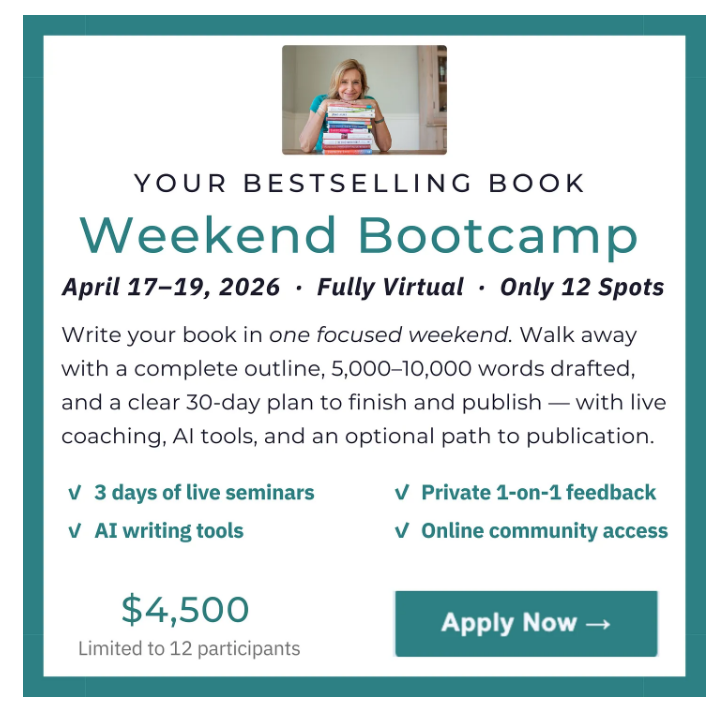
If you're ready to take your book seriously,
Register Today!
Get Weekly Tips for Writing & Publishing Your Book
Sign up below to receive The Next Chapter, the actionable free newsletter for high performers who are ready to become published authors, straight to your inbox every week.
Delivered weekly on Sundays. No spam, ever. Unsubscribe at any time.